
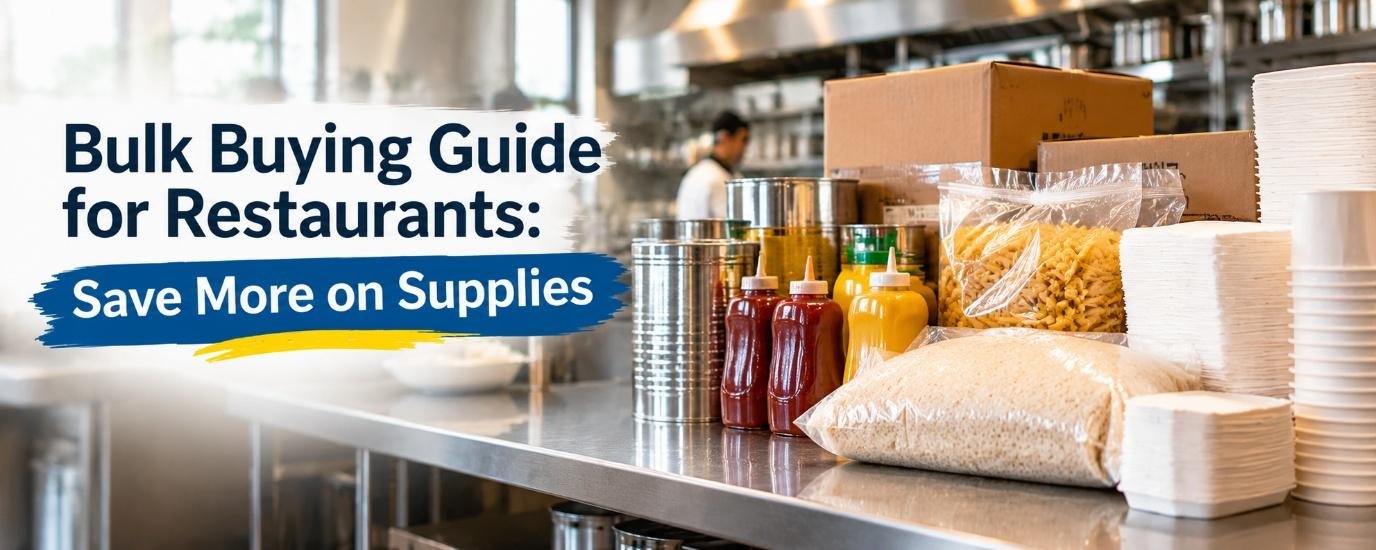
Running a restaurant in Canada means keeping a close eye on every dollar that goes through the kitchen. Food costs, labour, packaging, cleaning products, equipment, utilities, and delivery expenses can quickly put pressure on already tight margins.
That makes purchasing strategy increasingly important.
For many restaurants, cafés, bakeries, caterers, and other foodservice businesses, bulk buying can be an effective way to lower the cost of frequently used products. Buying larger quantities can reduce the cost per unit, simplify ordering, and help kitchens maintain reliable stock of essential ingredients and supplies.
But bigger orders do not automatically mean bigger savings.
Buying too much of the wrong product can tie up cash, overcrowd storage areas, and increase food waste. Successful bulk purchasing therefore depends on knowing what to buy, how much to order, and how quickly the restaurant will use it.
This guide explains how Canadian restaurant operators can approach bulk buying strategically and get more value from their foodservice purchasing.
Why Bulk Buying Matters for Canadian Restaurants
Cost management remains one of the biggest challenges facing Canada's restaurant industry.
Restaurants Canada reported in February 2026 that 88% of restaurant operators identified food costs as a top concern, while labour costs were cited by 89%. The organization also reported that, as of November 2025, 44% of restaurants were operating at a loss or breaking even.
That pressure makes every purchasing decision important.
As Kelly Higginson, President and CEO of Restaurants Canada, explained when discussing current industry conditions:
“This is still a very challenging market, as Canadians continue to face an affordability crisis and rising operational costs are squeezing operators’ margins.”
For restaurant operators, controlling purchasing costs without sacrificing menu quality is therefore an important part of protecting margins.
Bulk purchasing can help—but only when it is supported by accurate demand forecasting and good restaurant inventory management.
What Does Bulk Buying Mean for a Restaurant?
Bulk buying generally means purchasing food, beverages, disposables, cleaning products, or other restaurant supplies in larger commercial quantities rather than smaller retail packages.
For example, instead of purchasing several individual containers of cooking oil, a commercial kitchen might purchase a foodservice case. A busy pizzeria might order flour, tomato products, cheese, and packaging by the case. A café may purchase coffee, sweeteners, cups, lids, and napkins in larger quantities.
- Depending on the operation, common bulk restaurant supplies can include:
- Dry ingredients such as flour, rice, pasta, sugar, and spices
- Canned tomatoes, vegetables, beans, and sauces
- Cooking oils and condiments
- Frozen foods
- Meat and seafood
- Dairy products
- Coffee, tea, and beverage ingredients
- Takeout containers, cups, lids, napkins, and cutlery
- Cleaning chemicals and sanitation products
- Paper products and other everyday foodservice supplies
- The key is not simply purchasing large quantities. It is purchasing larger quantities of products that your operation can use efficiently.
How Bulk Buying Can Help Reduce Restaurant Costs
Lower Cost Per Unit
One of the main advantages of buying from wholesale food suppliers is the potential for a lower cost per unit.
Commercial pack sizes often spread packaging, handling, and distribution costs across more product. For high-volume ingredients, even a relatively small unit saving can become meaningful over hundreds or thousands of servings.
Consider an ingredient used across several menu items. Saving only a few cents per portion may appear insignificant, but over a full year of service, the cumulative savings can be substantial.
Restaurant operators should therefore compare unit cost, not simply package price.
Fewer Orders to Manage
Frequent small orders can create additional administrative work.
Staff may need to check inventory, prepare purchase orders, receive deliveries, verify invoices, and put products away every time an order arrives.
Buying appropriate products in larger quantities may reduce the frequency of ordering and help simplify restaurant supply management.
This can be particularly useful for shelf-stable products and high-use non-food supplies.
Better Availability of Essential Products
Running out of a core ingredient during service can create far more problems than the cost of the missing product.
A restaurant that unexpectedly runs out of frying oil, flour, takeout containers, gloves, or cleaning products may need to make an emergency retail purchase or temporarily change operations.
Maintaining sensible quantities of essential foodservice supplies can create a useful buffer against unexpected demand or delayed deliveries.
The Biggest Bulk-Buying Mistake: Ordering More Than You Can Use
Bulk purchasing only saves money when the product is actually used.
This is especially important for perishable foods.
Government of Canada research into food loss and waste identifies surplus inventory, inadequate storage, and inaccurate forecasting among the factors that contribute to food waste.
The lesson for restaurant operators is straightforward: a lower case price means very little if part of that case eventually ends up in the waste bin.
Before increasing an order quantity, ask:
How quickly will we realistically use this product?
A restaurant should consider average weekly usage, shelf life, storage capacity, seasonal demand, menu changes, and expected customer traffic.
This changes bulk buying from a simple purchasing decision into an inventory-management decision.
What Restaurant Supplies Are Best to Buy in Bulk?
Not every item should be purchased the same way.
Shelf-Stable Food
- Shelf-stable products are often among the easiest items to purchase in larger quantities.
- These may include:
- Rice
- Pasta
- Flour
- Sugar
- Dry beans
- Canned products
- Spices and seasonings
- Sauces
- Condiments
- Cooking oils
These products generally provide restaurants with more flexibility than highly perishable ingredients, provided storage requirements and best-before dates are properly managed.
High-Turnover Ingredients
Products used every day are strong candidates for bulk purchasing.
If a restaurant consistently uses the same tomato sauce, cooking oil, cheese, flour, chicken product, or seasoning across multiple dishes, larger foodservice packs may make financial sense.
Look at historical usage rather than guessing future demand.
Takeout and Disposable Supplies
- Disposable restaurant supplies are another category worth evaluating for bulk orders.
- Takeout containers, napkins, cups, lids, straws, bags, and disposable cutlery typically have longer usable lives than fresh food.
- Restaurants with steady takeout or delivery volume may therefore benefit from keeping reasonable case quantities on hand.
Cleaning and Sanitation Supplies
Commercial kitchens continuously use dishwashing products, surface cleaners, garbage bags, gloves, paper towels, and other sanitation supplies.
These products can often be purchased in commercial formats, making them another category where case purchasing may offer operational advantages.
Always follow manufacturer directions for storage, handling, dilution, and use.
Products That Require More Caution
Fresh produce, dairy, meat, seafood, baked goods, and other short-life products require more careful purchasing.
A case price might look attractive, but spoilage can quickly eliminate the savings.
Suppose a restaurant saves $15 by purchasing a larger case but ultimately discards $25 worth of unused product. The restaurant has not saved $15—it has increased its effective food cost.
That is why restaurant food purchasing should be connected directly to sales and inventory data.
Calculate the Real Cost Before Ordering
- When comparing restaurant food suppliers, avoid looking only at the advertised case price.
- Calculate the usable unit cost.
- For example:
- Case cost ÷ usable quantity = unit cost
- Then consider additional factors such as:
- Delivery fees
- Minimum order requirements
- Storage requirements
- Expected waste
- Product yield
- Portion size
- Staff preparation time
- A cheaper product is not always the more economical product.
- If one ingredient has better yield, less trimming, easier preparation, or lower waste, its true cost per serving may actually be lower.
- For restaurants, cost per usable portion can be more valuable than cost per kilogram.
Use Your Menu to Guide Purchasing Decisions
Your menu can reveal where bulk purchasing makes the most sense.
Start by identifying ingredients that appear across multiple dishes.
A restaurant might use the same chicken product in sandwiches, salads, wraps, and entrées. Tomato products may appear in pasta sauces, pizza, soups, and braised dishes. Cheese might be used across breakfast, lunch, and dinner items.
Using versatile ingredients across the menu can increase inventory turnover and make larger purchases easier to justify.
It can also reduce the number of separate SKUs a restaurant needs to manage.
Follow FIFO Inventory Management
- One simple inventory practice can make bulk buying significantly safer: FIFO—First In, First Out.
- Older inventory should generally be used before newer inventory, subject to food-safety requirements and product-specific date guidance.
- When receiving new restaurant supplies:
- Check the delivery against the purchase order.
- Inspect packaging and product condition.
- Verify relevant dates.
- Label products when necessary.
- Place newer stock behind existing usable inventory.
- Keep storage areas organized so products remain visible.
- Good rotation helps prevent older inventory from becoming forgotten behind newly delivered cases.
Know Your Storage Capacity
- A bulk order is only useful if the restaurant can store it properly.
- Before increasing quantities, check available:
- Dry storage
- Refrigerator space
- Freezer capacity
- Shelving
- Food-safe storage containers
- Overloading storage areas can make inventory difficult to track and may interfere with proper product handling.
- For refrigerated and frozen products, maintaining required storage conditions is particularly important.
- Bulk purchasing should fit your kitchen—not overwhelm it.
Build Relationships With Restaurant Suppliers
Price matters, but a reliable restaurant supplier offers value beyond the invoice total.
When evaluating foodservice suppliers, consider product availability, delivery schedules, order minimums, case sizes, customer service, substitutions, and the consistency of products supplied.
Restaurant operators can also ask suppliers about alternative pack sizes, comparable products, seasonal availability, and products that may offer better yield.
The goal should be to find the best overall purchasing value rather than automatically selecting the lowest listed price.
Review Inventory Before Every Major Order
- Restaurant purchasing decisions become much easier when operators know exactly what they already have.
- Regular inventory counts can identify:
- Overstocked products
- Slow-moving ingredients
- Unexpected shortages
- Waste patterns
- Changes in ingredient usage
- Products approaching their usable date
- This information can improve future ordering decisions.
For higher-volume operations, restaurant inventory management software or a point-of-sale system integrated with inventory tools can make usage patterns easier to track.
Smaller restaurants can still benefit from a consistent spreadsheet or manual inventory process.
The important factor is consistency.
Set Par Levels for Important Supplies
- A par level is the amount of inventory a restaurant aims to have available to cover normal operations between deliveries.
- Rather than ordering based on instinct, restaurants can establish par levels using actual usage.
- A simple approach is:
- Expected usage between deliveries + safety stock = target inventory
The appropriate safety stock will depend on supplier reliability, demand variability, shelf life, storage capacity, and how critical the product is to the menu.
Par levels should not remain fixed forever.
Review them when sales patterns, menu items, seasons, delivery schedules, or operating hours change.
Watch Seasonal Demand
Canadian restaurants often experience significant seasonal shifts.
Patio season can change beverage and appetizer demand. Winter may increase demand for soups, hot drinks, and comfort foods. Tourism can dramatically affect restaurants in destination markets, while holidays and major events can change customer traffic.
Ordering the same quantity every month can therefore lead to shortages during busy periods and excess inventory during slower ones.
Use historical sales data and upcoming reservations, promotions, holidays, weather patterns, and local events to adjust purchasing plans.
Track Food Waste
- One of the best ways to determine whether bulk purchasing is actually working is to measure waste.
- Record what is being discarded and why.
- Common reasons may include:
- Spoilage
- Overproduction
- Incorrect preparation
- Portioning errors
- Damaged products
- Expired or outdated inventory
- Excess purchasing
If a particular ingredient is repeatedly being discarded, reducing its order quantity may save more money than negotiating a lower case price.
The Government of Canada has identified inaccurate forecasting and poor inventory management among the factors contributing to food loss and waste. Better purchasing data can therefore support both cost control and waste reduction.
Don't Ignore Non-Food Restaurant Supplies
- Food receives most of the attention when operators discuss bulk purchasing, but non-food products can represent another opportunity.
- Restaurants regularly purchase items such as:
- Takeout packaging
- Disposable gloves
- Foil and food wrap
- Parchment paper
- Garbage bags
- Cleaning chemicals
- Dishwashing supplies
- Napkins
- Paper towels
- Cups and lids
Because many of these items have a relatively long storage life, restaurants may have more flexibility to purchase them by the case when storage space permits.
Again, calculate the unit cost and expected usage before ordering.
Create a Smarter Restaurant Purchasing Strategy
- Bulk buying works best as part of a broader procurement strategy.
- Instead of asking:
- “Can we get a cheaper price if we buy more?”
- Ask:
- “Will buying more reduce our total cost without increasing waste or tying up unnecessary cash?”
- That distinction matters.
- For every major bulk purchase, consider four questions:
- Usage: How quickly do we use it?
- Savings: What is the actual unit or portion cost?
- Storage: Can we store it correctly?
- Waste: Are we likely to use the entire quantity?
- If all four answers support the purchase, buying in bulk may make sense.
Bulk Buying Is About Buying Better, Not Simply Buying More
Canadian restaurants continue to operate in an environment where controlling costs is essential. Restaurants Canada reports that the country's foodservice industry purchases approximately $43 billion in food and beverage products each year, demonstrating just how important procurement is to the sector.
For an individual restaurant, smarter purchasing can start with something much smaller: understanding exactly what the kitchen uses.
Bulk food and wholesale restaurant supplies can help operators lower unit costs, reduce ordering frequency, and maintain dependable inventory. But those benefits only appear when purchasing quantities match actual demand.
Track usage. Compare unit costs. Monitor waste. Rotate inventory. Review suppliers. Adjust par levels as demand changes.
The objective is not to fill the storeroom with the largest possible order.
It is to have the right restaurant supplies, in the right quantities, at the right cost—so every purchase supports a more efficient and financially sustainable operation.