
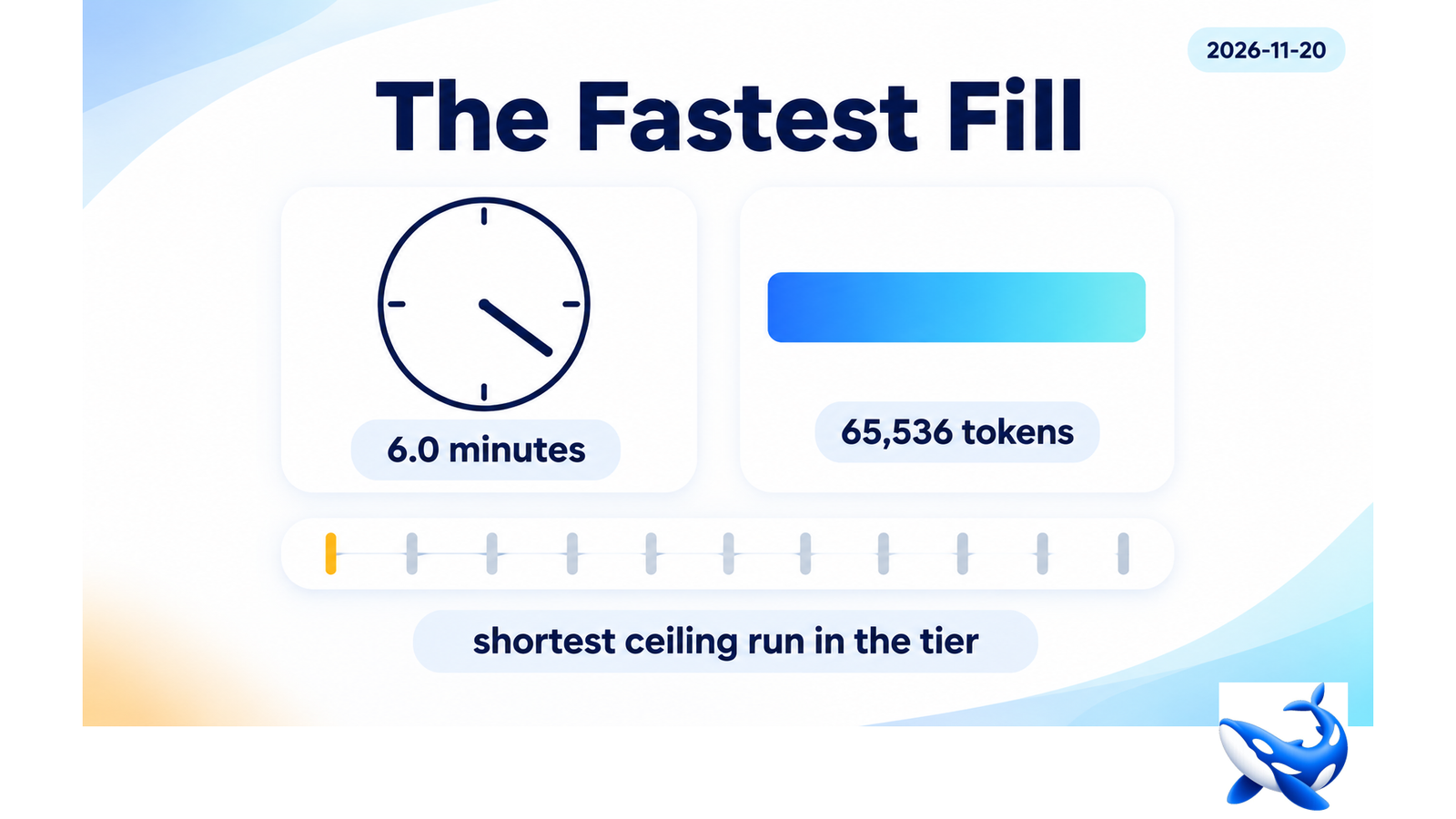
Six minutes is the whole of this card's ceiling run, and no other cyber card finishes its own maximum output faster. OrcaRouter measures the rate that produces the figure. The rate and the ceiling are both on OrcaCyber Hy4 Flash throughput: 182.1 output tokens a second against a 65,536-token maximum.
The ranking
| card | ceiling | tok/s | fill |
|---|---|---|---|
| Hy4 Flash | 65,536 | 182.1 | 6.0 min |
| Hy4 | 65,536 | 135.1 | 8.1 min |
| Zero 1.0 | 128,000 | 240.2 | 8.9 min |
| Zero 1.5 | 128,000 | 195.6 | 10.9 min |
| MiniMax M3.1 Flash | 131,072 | 110.3 | 19.8 min |
| Ultra 1.0 | 131,072 | 109.2 | 20.0 min |
| GLM 5.3 | 128,000 | 91.6 | 23.3 min |
| Qwen3.8 Flash Next | 131,072 | 91.0 | 24.0 min |
| Flash 1.0 | 393,216 | 210.9 | 31.1 min |
| GLM 5.3 Flash | 131,072 | 66.4 | 32.9 min |
| MiMo V2.6 Flash | 131,072 | 51.7 | 51.7 min |
| K3.1 Pro | 943,718 | 81.4 | 193.2 min |
The first place is partly a consequence of the smallest ceiling in the tier. Filling 65,536 tokens at 182.1 a second takes six minutes; a card with double the ceiling would need twelve even at the same speed.
So the more interesting column is the third one against the first. Zero 1.0 is faster at 240.2 tokens a second and still takes 8.9 minutes, because it fills 128,000 tokens. Hy4 Flash trades 58 tokens a second of raw speed for half the work, and wins the ranking.
Third-fastest in the tier and fastest to finish are different claims, and this card is the second, not the first.
Why a short ceiling run matters
A ceiling run is the worst case: the longest thing a card can be asked to do. It sets the timeout a client must configure if it never wants to lose a completed response.
Six minutes is a timeout a synchronous HTTP client can plausibly hold without a keepalive hack. Against K3.1 Pro's 193.2 minutes it is a different architecture: the premium card requires asynchronous job handling, a poll loop or a streaming reader that never disconnects, and the cheap card does not.
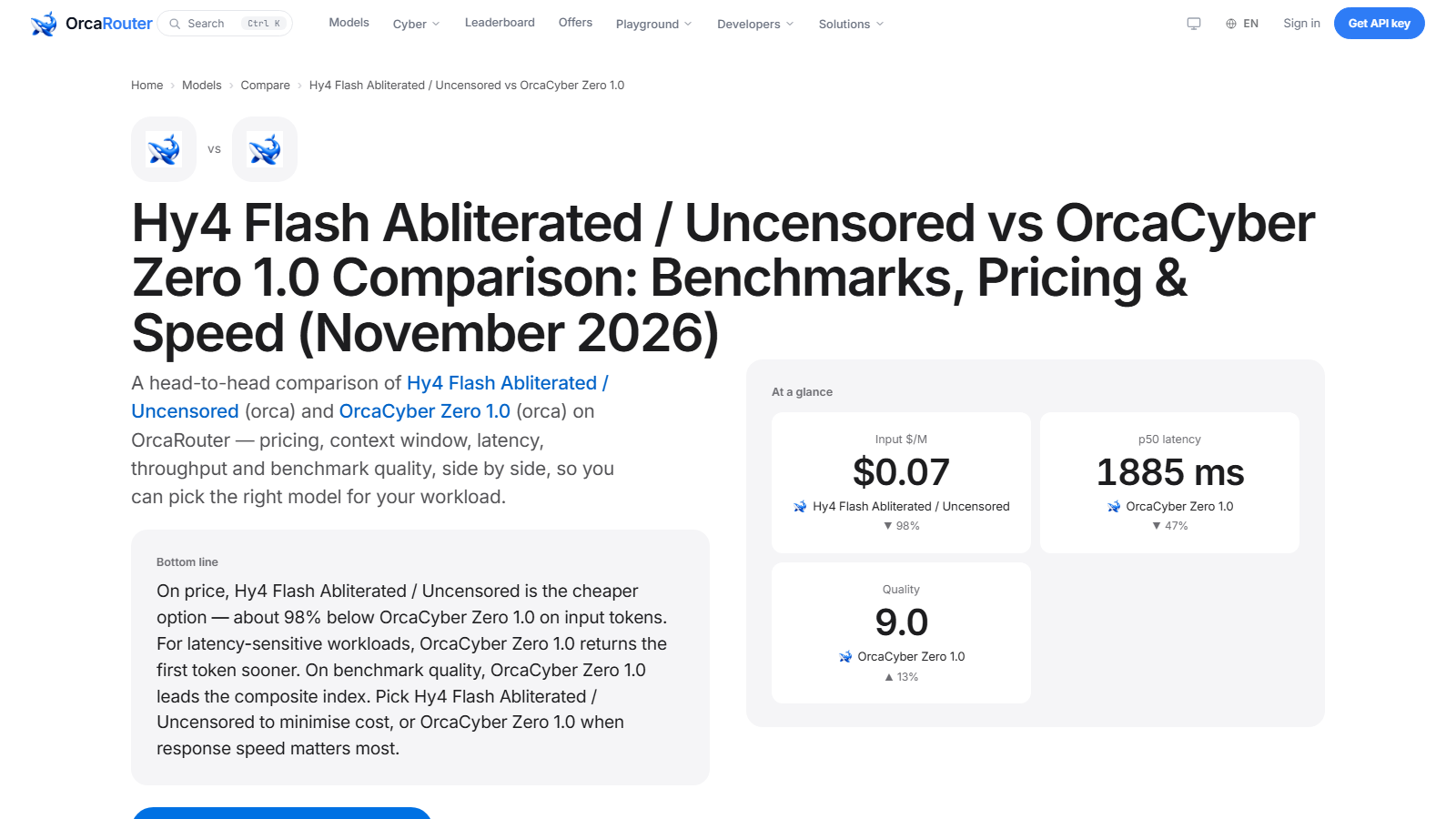
That is a real engineering difference and it is not visible in a price table. A team comparing $0.07 input against $2.00 input will notice the price; the timeout consequence only shows up after the first long generation times out.
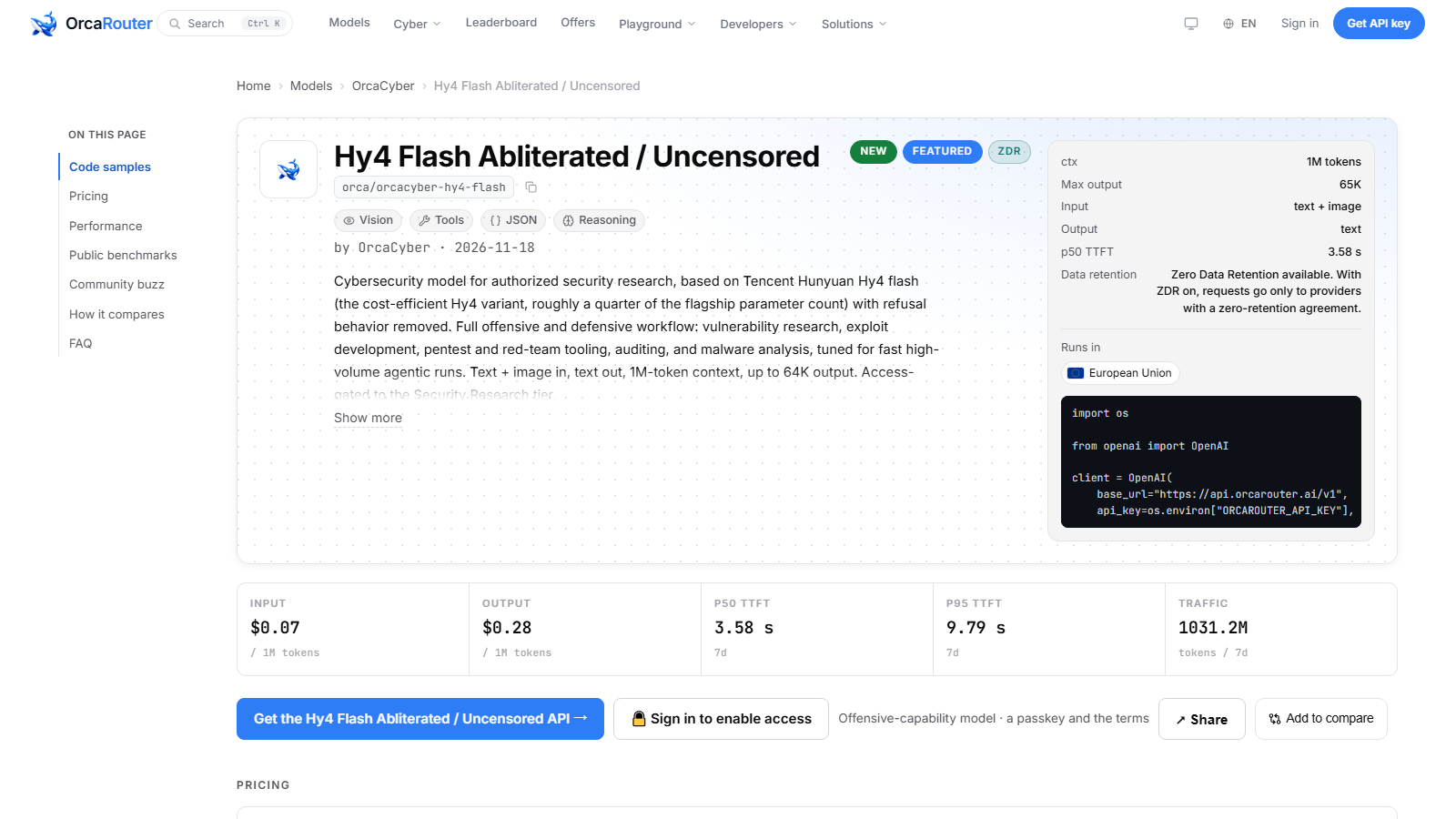
The card's own published p50 is 3,579 ms and its p95 is 9,834 ms, which is a different measurement — time to first token — and says nothing about the total duration of a long answer. Conflating the two is the common error, and they differ by a factor of about 150.
The other side of a small ceiling
The same field that makes the card fast to fill makes it unable to produce a long artefact. Sixty-five thousand five hundred thirty-six tokens is roughly 49,000 words of English, which is a substantial report but not a full repository audit, an annotated patch series or a long disassembly walkthrough.
Against the tier's largest ceiling it is 6.9% — K3.1 Pro offers 943,718. Against the median million-window card it is exactly half.
So the card's position is coherent rather than compromised: it is built to read a lot and say a little, fast. A job that wants a 65,000-token answer gets it in six minutes; a job that wants a 200,000-token answer gets a second call or a different card.
The published fields do not say which jobs the vendor intends, so this is our reading of the arithmetic rather than a stated positioning.
Throughput, errors, and the effective figure
An error rate of 0.17% leaves the effective rate at 181.8 tokens a second — a 0.3-token correction, the smallest absolute movement any card in the tier shows.
| card | raw | err % | effective |
|---|---|---|---|
| Zero 1.0 | 240.2 | 0.09 | 240.0 |
| Flash 1.0 | 210.9 | 0.17 | 210.5 |
| Zero 1.5 | 195.6 | 0.09 | 195.4 |
| Hy4 Flash | 182.1 | 0.17 | 181.8 |
| Hy4 | 135.1 | 0.10 | 135.0 |
| MiniMax M3.1 Flash | 110.3 | 0.18 | 110.1 |
| Ultra 1.0 | 109.2 | 0.72 | 108.4 |
| GLM 5.3 | 91.6 | 0.44 | 91.2 |
| Qwen3.8 Flash Next | 91.0 | 1.60 | 89.5 |
| K3.1 Pro | 81.4 | 0.19 | 81.3 |
| GLM 5.3 Flash | 66.4 | 0.44 | 66.1 |
| MiMo V2.6 Flash | 42.3 | 0.42 | 42.1 |
The correction is worth doing because it reorders the bottom of the table and not the top. Qwen3.8 Flash Next at 1.60% loses 1.5 tokens a second; MiMo V2.6 Flash at 0.42% loses 0.2. The band's four fastest cards are effectively unchanged.
For this card the effective 181.8 is the number to plan a batch against, and the six-minute ceiling run becomes six minutes and one second.
Six minutes and what fits inside it
A 65,536-token ceiling filled in 6.0 minutes is the shortest ceiling run in the tier, and the practical question is which jobs a six-minute window can hold.
| job | output tokens | time at 182.1 tok/s |
|---|---|---|
| a verdict with a justification | 500 | 3 s |
| a vulnerability write-up | 3,000 | 16 s |
| a full function patch | 8,000 | 44 s |
| a module audit report | 40,000 | 3.7 min |
| a maximum-length answer | 65,536 | 6.0 min |
Every row fits inside a ten-minute client timeout, and the largest fits inside six. That removes an entire class of engineering work: no job queue, no poll loop, no reconnect logic, no partial-response reconciliation.
The trade is the ceiling. A 40,000-token audit report is 61% of what this card can produce in one call, which leaves little room to be wrong. A card with 131,072 tokens of ceiling would run the same report at 31% and could absorb a longer draft.
So the six-minute fill and the small ceiling are the same design decision seen from two sides. The card is fast because it writes little, and it writes little because a fast card is the product.
One number is worth carrying out of the table. Six minutes is inside the default timeout of virtually every HTTP client and inside the billing ceiling of every serverless runtime worth using. That is not a performance claim — it is a deployment claim, and it means a team can put this card behind a plain request-response endpoint rather than building an asynchronous path. The cards above thirty minutes cannot be deployed that way at their ceiling.
For a buyer the six-minute figure is best read as a statement about how the card can be deployed, and the ceiling is best read as a statement about what it can be asked. The two together describe a small, quick, well-bounded unit of work.
OrcaCyber Hy4 Flash fills its entire 65,536-token ceiling in 6.0 minutes — the shortest ceiling run in the thirteen-card tier, ahead of Hy4 at 8.1 and Zero 1.0 at 8.9. It gets there at 182.1 output tokens a second, third-fastest overall, and its 0.17% error rate leaves an effective 181.8.
The ranking is partly the small ceiling and partly the speed, and the two are separable: Zero 1.0 generates faster and still takes 8.9 minutes because it fills twice as much. Six minutes is a timeout a client can hold synchronously, which the premium cards' 20-to-193-minute runs are not.
Sourcing note: the output ceiling, context window, throughput, error rate, latency percentiles and price rows are read from the OrcaCyber Hy4 Flash model API and card page on orcarouter.ai on 2026-11-20, with throughput, latency and error rates being OrcaRouter production telemetry for the seven days to that date. Fill times, effective throughput and the ranking are our own arithmetic. No competitor product is named or compared. Checked 2026-11-20.